Saturday, August 20, 2011

Fideos y Frijoles


Basil sprouting out of the stone next to a wild milkweed plant in Casa Carmen Bed and Breakfast in San Miguel de Allende.

To be in San Miguel is to experience total hospitality, civility, gentlity, and beauty. Whatever this maligned country of Mexico is undergoing, this place is certainly an oasis. I am once again enjoying the warmth of Casa Carmen, the bed and breakfast here in San Miguel de Allende where I bring my students for a Spanish immersion program every summer.

This week, my husband and I are here together, visiting friends and enjoying the many culinary delights the city has to offer.  My husband is an Italian who is passionate and knowledgeable about cooking.   Being married to him these many years, it is no surprise that in this Mexican-Italian marriage there is so much blending of what we both love.  For example, pasta and beans.

In Mexico, it is hard to avoid beans in all their different forms. Here at the market, I always find pale green frijoles peruanos (Peruvian beans) and make a dish that would be welcome on any table in Italy. It is a replication of a dish called pasta e fagioli, an Italian peasant food.  All of the necessary ingredients can be found in Mexico or in the States. Of course, the pasta itself can be any kind of small pasta. This dish is a marriage of cultures and convenience and, I must say, a love match. I'll call it Fideos y Frijoles a la Italiana.


Fideos y Frijoles a la Italiana


Recipe Type: Soup


Author: Gilda Valdez Carbonaro


Prep time: 20 mins


Cook time: 3 hours


Total time: 3 hours 20 mins


Serves: 4 to 6


Ingredients:
  • 1/2 cup of olive oil
  • 1/2 cup chopped pancetta or bacon
  • 1 stick celery, minced
  • A few celery leaves roughly chopped
  • 1 clove garlic
  • 1 large carrot, chopped or minced
  • 3 tomatoes, chopped finely
  • 4 cups (approximately) of white navy beans or cannellini, or pale green Peruvian beans
  • 1 cup small pasta or broken spaghetti
  • Salt to taste in sauce and in pasta water
  • 1 cup basil leaves
Instructions:

Beans
  1. Drop them in boiling water and turn down the heat.

  2. When the water is at a low simmer, lower the heat and cover the pot with the lid slightly shifted to allow some steam out of the pot.

  3. Let them cook at a low temperature for about 3 hours. About midway through the cooking, add a clove of garlic and salt to taste.

  4. If you run out of water, add more, but you should only add boiling water. Adding cold water will make the beans hard.

  5. The beans should be soupy when they are ready and very soft.


Sauce
  1. In a pan, brown the bacon in the olive oil until golden brown.

  2. Sauté the celery and carrot in the same pan for a few minutes then add the garlic.

  3. Add the tomatoes and continue to sauté for a few minutes, then cover and keep on low heat until all the ingredients are "guisados" (cooked in the oil).

  4. Take a small portion (about a cup) of the beans and put them in the blender so that you can thicken the soup in the beans.

  5. Put these blended beans back in the pot.

  6. Add the bacon, carrot, tomato, etc. sauce and cook for 5 minutes.

  7. Put the pasta in boiling, salted water in a small pot and, before it is completely soft, strain it and add it to the beans. Let it cook for another 5 minutes. Don't let the pasta get too mushy.

  8. Serve in deep bowls and garnish with sprigs of basil.
Notes

My mother always cooked beans in a clay pot, but any stainless steel pot will do the job. You can shorten cooking time by soaking the beans overnight, throwing out the water the next day and cooking them in fresh water. Also, if you have a high quality extra-virgin olive oil on hand, drizzle a bit on the served plate. You will get the scent of the oil plus the fresh basil as you take your first spoonful.


Thursday, August 11, 2011

Chila-Migas


There is quite a bit of debate about the differences between chilaquiles and migas.  They are both considered Mexican comfort foods and are made with some combination of corn tortillas, salsa, cheese and eggs, depending on whom you ask.  Some argue that it has to do with the way the tortillas are fried and when the salsa is added.  Others contend that chilaquiles are made with eggs and baked while migas are simply fried tortillas with onions, cheese and salsa.  Is this a regional dispute?  A case for a panel of Food Network judges?  The stuff that family feuds are made of?  Even Gilda "La Madrina" and I can't seem to agree.

During a recent discussion about this, Gilda remembered that she had written down my mother's recipe for chilaquiles while my mother dictated it to her over the phone--when they were teenagers!  Gilda dug around and found the recipe.  Written in pencil and the page now yellowed, the instructions are vague and fail to settle the question of whether chilaquiles and migas are different interpretations of the same dish.

I remember my mother frying triangles of corn tortillas with onion, then adding salsa and scrambled eggs.  She called this dish chilaquiles, not migas.  I have made the dish pretty much the same way over the years.   But in honor of the recipe as dictated and written by two best friends over 40 years ago, I have deviated from my usual practice.  This is the result and, as is the prerogative of a daughter/ahijada, I have renamed this dish Chila-migas.

What is the tradition in your family?  Are you a chilaquiles purist or a migas connoisseur?  Enlighten us!


Chila-Migas


Recipe Type: Breakfast

Author: Gilda Claudine

Serves: 4 to 6

Ingredients

  • 1/4 cup of Canola oil

  • 1/2 chopped onion

  • 1 tomato, diced

  • 1 serrano or jalapeño pepper, chopped

  • 5 corn tortillas

  • 6 eggs

  • Salt and pepper to taste

  • Queso fresco or queso cotija, about 1/2 cup or more

Instructions
  1. In a heavy skillet, heat half of the oil.

  2. Sweat the onions, tomato and pepper and set aside when done (about 10 minutes).

  3. Cut 5 tortillas into triangles.

  4. Add the rest of the oil to the skillet and, when hot, fry the tortillas.

  5. Remove the tortillas with a slotted spoon/spatula and drain on a paper towel.

  6. Heat the oven to 350 degrees.

  7. Return the tortillas to skillet, layering the bottom with them.

  8. Add tomato mixture and another "layer" of tortillas.

  9. Whisk the eggs and add to the skillet, allowing them to cook.

  10. Add salt and pepper to taste.

  11. When the eggs are cooked halfway through, remove from the burner.

  12. Add the desired amount of cheese and place skillet in the oven.

  13. The chila-migas are ready when the cheese is melted and the eggs are cooked through.

  14. Serve with slices of avocado, red or green salsa, and garnish with chiles.
Notes

I chose to sauté the onion, tomatoes and chiles and did not add salsa to the dish. Adding a red or green salsa when layering the tortillas in the skillet is optional. If you choose not to add salsa at this stage, serve the dish with a side of salsa.


Thursday, August 4, 2011

Corundas

For the ancient inhabitants of Mexico and, in fact, all of the Americas, corn was king.   Maize was deified, and the variety of meals based on corn were nearly infinite. The modern-day Mexican eats corn in some shape or form every day, probably mostly in the form of tortillas. But each region of Mexico has a different way of consuming corn, in the form of gorditas, garnachas, tamales, atoles, guaraches, etc.

North of the border, little is known or understood about the regional foods of Mexico. This past June, when I took my students to Mexico for a summer Spanish immersion course, I introduced them to corundas, a kind of tamal originating in Michoacan (shown here:)


The tamal is wrapped in the green outer leaf of the corn, shaped, more or less into a triangle. You can add filling to the masa or simply pour cream and green (tomatillo) or red salsa on top. Whenever it can be found, tequesquite, a mineral salt, is used as a leavening agent when cooking the masa, a practice that dates back to the Aztecs. A good substitute for tequesquite is baking soda.


Corundas


Recipe Type: Appetizer

Author: Gilda Valdez Carbonaro

Prep time: 30 mins

Cook time: 1 hour

Total time: 1 hour 30 mins

Serves: 4 to 6

Ingredients


  • 2 ½ lbs corn masa prepared according to the instructions on the bag

  • 3 teaspoons baking powder

  • 1 cup shortening

  • cup milk

  • Husks of 10 tomatillos

  • Green corn husks

  • Salt to taste

Instructions


  1. Boil the tomatillo husks in about 1 ½ cups water with the baking powder.

  2. Strain the water, disposing of the husks, and mix the broth with the milk.

  3. Beat the shortening until it is fluffy.

  4. Very graduallly, add to this shortening the milk-tomato-water mixture and continue to beat it.

  5. When it is well mixed, very gradually add the corn dough (masa) mixture, beating more.

  6. Add salt to taste.

  7. Make a cone shape with the corn husks and scoop dough into the cones.

  8. Wrap the husks into a triangle shape and tie with a thin piece of corn husk or cooking twine.

  9. Place the corundas in a steamer and steam for approximately one hour.

  10. Serve with crema mexicana and a green or red salsa.


Notes


Corn masa can be found in most grocery stores in the U.S. One well-known brand is Maseca.


Tuesday, July 19, 2011

Gazpacho a la Mexicana

When my mother was newly widowed, my sisters and I encouraged her to take a trip to Spain with people her age and that is how she came to visit that country for the first time. Our mother, with her youthful and positive attitude was soon the star of the traveling group and the tour guide's pet. Speaking Spanish certainly was a plus; she was the one septuagenarian in the group who was linguistically and culturally independent.  She returned from this month long trip full of stories of her adventures in Spain.

One day, a few months after she had returned, we sat on her bed, chatting about the trip as we went through brochures of places in Spain she had visited. Among the piles of papers was a recipe typed with a Royal typewriter on onion skin paper.  A recipe for gazpacho. I wish I could remember what she told me that day about the exact circumstances in which she was given this recipe by a waiter in a restaurant.

The truth is, my mother always had a way of inspiring people to do things for her. Apparently, as best I can recall, my mother had so much enjoyed this gazpacho—something she had tasted for the first time in Spain—that she had asked the waiter how it was made. The waiter, an old gentleman, disappeared long enough to type out the recipe and proudly hand it to her. I still have the original copy of the recipe.


For me, also, it was the first time I had eaten gazpacho and I found it to be such a perfect way to blend the bounty of summer into one fresh taste. My husband adores this, but when he's not around, I add chile to it (He doesn't tolerate chiles.) to give it a bit of Mexican flavor.


Gazpacho a la Mexicana


Recipe Type: appetiser, soup

Author: Gilda Valdez Carbonaro

Serves: 4

Ingredients


  • 5 medium tomatoes or an equivalent quantity of cherry tomatoes (they're sweeter)

  • 1 quarter medium yellow or red onion

  • 1 large peeled cucumber (save the other half for garnish)

  • 1/2 of a red bell pepper

  • 1 clove garlic

  • 2 slices old French bread

  • Jalapeño or serrano pepper added as needed

  • 1/2 cup extra virgin olive oil (the best quality you have)

  • 2 tbls white vinegar (or more if you prefer)

  • Sea salt to taste

Instructions

  1. Blend all the ingredients starting first with the tomatoes, then the bell pepper and garlic

  2. Add the oil and vinegar and then the rest of the ingredients.

  3. Serve chilled with garnish of chopped, sliced, cucumbers, fresh corn kernels, and croutons sprinkled on top of each bowl of gazpacho.

Monday, July 4, 2011

Crossing Frontiers of the Mind


This 4th of July was a quiet one for me, nothing like others in the past. Those, both of my childhood and my past adult life, were filled with outdoor parties, carne asada on a big grill, plenty of pico de gallo, frijoles borrachos, slices of crispy watermelon, lemonade. The carefree laughter of children darting among the adults, chasing illusive fireflies in the last streaks of fading sunlight.  Most memorable is one when, newly arrived here in the nation's capital, my husband, our son, Alex, and I went on bicycles to the mall to watch the fireworks.  The  evening was full of pure wonder and delight, all three of us thrilled to see the fireworks against the silhouette of the Washington Monument.

Today, through my window, I see the flags on every lawn, planted into the ground every year by someone in the neighborhood. It would surprise most people that for me these flags make my heart heavy and my soul mournful. For me, they stand for things other than backyard parties.  They represent an image in slow motion of folded flags handed to grieving mothers by white-gloved hands on splendid lawns with geometrically aligned rows of new tombstones, draped caskets of beloved youth. They bring forth in me a need to understand what cannot be explained.

In spite of the path I've walked, I remain a person who dreams fervently of an enlightened world where there is compassion, tolerance, and understanding as opposed to ignorance, hate, and fear...a world where truth and justice reign. And I believe in a sense of common responsibility. In the words of Chilean poet, Gabriela Mistral:

"Donde haya un árbol que plantar, plántalo tú. Donde haya un error que enmendar, enmiéndalo tú. Donde haya un esfuerzo que todos esquivan, hazlo tú. Sé tú el que aparta la piedra del camino."

(“Where there is a tree to plant, plant it yourself. Where there is an wrong to right, do it yourself. Where there is an effort that others avoid, do it yourself. Be the one that moves the stone from the road.”)

How better to attempt to bring about change than to teach? I am truly fortunate.

As a teacher of foreign languages, I have, with the help of teacher colleagues, for the past 4 years worked on a program of language and cultural immersion, taking middle school boys to Mexico to experience first hand  the culture of a country that has been so maligned by the U.S. media. In San Miguel de Allende they are introduced to authentic Mexican food, weaned from soft drinks only to discover the fresh aguas naturales for which Mexico is known.  They take cooking classes, play soccer and basketball with the locals.  They learn to dance, study Spanish, perform community service, and learn to acknowledge adults when they enter a room unlike many of their adolescent peers on this side of the border.

Through them I undoubtedly touch the future. I stand back and watch in awe at how they begin to see the world from a new perspective, because:

Travel is fatal to prejudice, bigotry, and narrow-mindedness.” – Mark Twain

I am including a recipe for frijoles borrachos as my parents made them when I was a child, so many July Fourths ago. Later this week, I look forward to bringing you some of the recipes I discovered in San Miguel de Allende with my brood of students.


Frijoles Borrachos


Recipe Type: Side dish


Author: Gilda Valdez Carbonaro


Serves: 8


My mother always had beans in the house. They were made in a clay pot, but they are perfectly fine cooked in anything other than clay.  Once they are cooking at a low flame you don't have to "watch" them.


Ingredients
  • 1 lb. pinto beans

  • 3 serrano peppers

  • 3 strips bacon (chopped in 1 inch pieces and browned separately)

  • 1 onion (chopped)

  • 3 tomatoes (chopped)

  • cilantro to taste, chopped (about 1 cup)

  • salt to taste (about 1 tbsp)

  • cup beer


Instructions
  1. Clean the beans, picking out bits of dirt from them and rinse them; you do not have to soak them overnight.

  2. In 5-6 qrt. kettle, cover them with plenty of water, bring them to a boil, lower the heat and cover.

  3. After about an hour, when they've lost their spotted color, add the salt and allow them to continue to cook for another forty minutes approximately, or until they are almost completely soft. Smash a few of them with a large spoon or a potato ricer so that they create a bit of "sauce."

  4. Add the chopped onions, chopped tomatoes, cooked bacon with some of the bacon fat, and serrano peppers; cook for a half hour more and then add the chopped cilantro and beer allowing the flavors to blend for another 10 minutes.

Friday, June 24, 2011

Calabacitas de mi Casa


As a teenager, I had a plan: to graduate, leave home—and go to college to study art. It didn't exactly work out that way.  As John Lennon says in his song Beautiful Boy, Life is what happens when you're busy making plans. By the time I graduated from high school, my college fund had dried up; it had been used to tide us over after a family business reversal.

But, as the saying goes "No hay mal que por bien no venga."  It wasn't the end of the world.  In fact, there were advantages.  For one thing, I didn't pay a penny for my education at the local college where I ended up for two years, since I was on scholarship there.

Still, there were dramatic changes at home.  My mother, for the first time, went to work outside the home. It was traumatic for her as she had always been at home for  my father, two sisters and me. But dire necessity dictated this change.

Many problems arose from this sudden adjustment in the way we did things. The family, for example, was now in a terrific tizzy about who would prepare midday lunch for my father.  My sisters were still in school during the day and hiring a housekeeper to make his lunch was unthinkable.

My father awoke everyday at an ungodly hour to make his own fiery, chile-laden breakfast. Throat-burning chile vapors floated through the house at 6 am, waking the whole house. To our added alarm, he often left the frying pan on the fire as he left the house for work.  Certainly, my mother felt he could not be trusted to prepare his own lunch.  

Hence, the duty to uphold this family routine fell on me as the oldest but also because I finished my morning classes at the local college by 11 a.m. and had plenty of time to get home to prepare lunch for my father. By that time, I had learned at my mother's side how to prepare our typical family meals. One of these was calabacitas con pollo, which we always ate with corn tortillas hot off the griddle. My father liked his tortillas crackly and I liked mine soft.


I can imagine now so many years later that Papá, who must have felt in desperate straits at the time, was happy to arrive at noon and still find that some things hadn't changed. His eighteen-year-old daughter was home from classes with a meal waiting for him. We would sit down to a plate of calabacitas con pollo—with soft and crackly tortillas—and savor our new tradition.   After lunch he would lie down for a quick siesta before returning to work and I would rush off and still arrive on time for afternoon classes.

After two years at the local college, I finally left home  to continue my studies. As it turned out, I left art for my other love: language and linguistics. I married, had a child and the calabacitas dish soon become a part of our family tradition as one of the first solid foods (minus the chiles) I gave my baby, Alex. I used a food mill to give the zucchini and other vegetables a consistency a baby could handle.


What food traditions have you carried on to your children and grandchildren?  Are there any recipes that have special meaning for you?


Calabacitas con pollo


Recipe Type: Main

Author: Gilda Valdez Carbonaro

Prep time: 20 mins

Cook time: 35 mins

Total time: 55 mins

Serves: 4

Ingredients


  • 1 lb of chicken pieces: wings, drumsticks, thighs etc.

  • 2 lbs zucchini chopped into cubes

  • 1 onion, chopped

  • 2 medium sized tomatoes, chopped

  • tsp comino powder (grind your own in a molcajete if you prefer)

  • tsp ground pepper

  • 2 serrano chiles

  • 4 tablespoons (approximately) of olive oil

  • Kernels cut from 2 fresh corn cobs

  • Salt to taste

Instructions


  1. In a large heavy pan, brown the chicken pieces in the oil over medium to high flame for about 15 minutes.

  2. Add all the rest of the ingredients, lower the heat, cover and cook for about 20 minutes, until all the flavors have come together.

  3. Be careful not to pop the serrano chiles, unless you want a spicier version. If you leave these chilies intact, they will provide flavor without making it overly spicy.
Note: I often cook this with pork, instead of chicken. If you use pork, be sure to cut it in small cubes, and brown them well, so that this flavor blends with the other ingredients. 

Thursday, June 9, 2011

A Quesadilla Commentary


I can't figure out why restaurants offer quesadillas on their menus so different from those found closer to the border and in Mexico proper.  I am not opposed to new twists on traditional foods or even so-called fusion foods (unlike La Madrina, who is much more of a traditionalist than I am), but why mess with a good thing?

Dear American Restauranteurs, a quesadilla is not baked in an oven like a pizza.  It is not cheddar and monterrey jack and mozzarella cheeses layered between two flour tortillas and grilled like a panini.  It is not even a prodigious serving of cheese, chicken and onions stuffed in a flour tortilla.  And it is most definitely not goopy, make-believe cheese (read: nacho cheese sauce) in a cripsy flour tortilla and deep-fried.


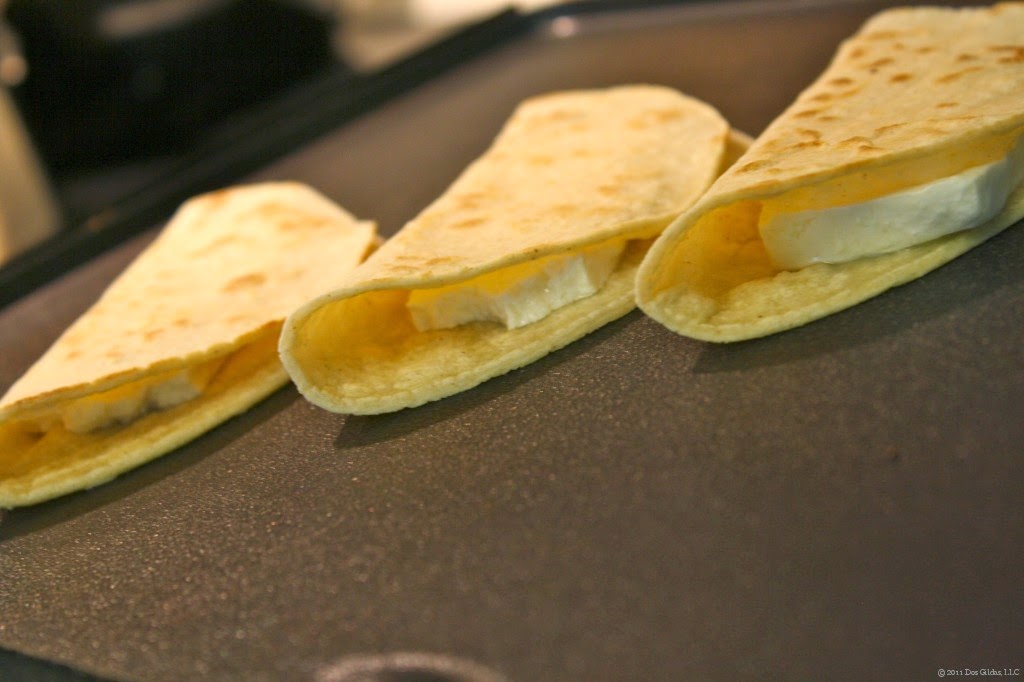
Quesadillas are quintessentially uncomplicated, which is why it seems almost absurd to include a recipe here.  Of course, in Mexico some variations are found, perhaps the addition of huitlacoche, a corn fungus and delicacy, for example.  The essence of the quesadilla remains the same, however: simple and savory.

As a parent, quesadillas, are my go-to food.  They are easy to prepare and children really do love them.  But I usually make them with corn, not flour, tortillas and just a sliver—not mounds—of cheese, either Mexican asadero or queso fresco when I can find it. This is the way my mother and grandmother made them, always with a spill of salsa or a heap of aguacate (avocado) on the side.  For my kids, I skip lo picante (the spice) but serve with avocado or fruit instead.


Mexican Quesadillas


Recipe Type: Appetizer, Snack

Author: Gilda Claudine

Prep time: 5 mins

Cook time: 5 mins

Total time: 10 mins

Serves: 1 - 2

Ingredients


  • Corn tortillas

  • 3 slices of cheese, preferably Mexican asadero or queso fresco.

Instructions
  1. Heat the tortillas on a comal or in heavy skillet over a medium flame.

  2. Place a slice of cheese on one half of the tortilla.

  3. When the cheese begins to melt, fold the tortilla over.

  4. Flip the tortilla to the other side.

  5. The quesadilla is done when the cheese is melted.

Notes

There is no need to use oil in this recipe.